Read the CBCT
Learn to assess anatomy, bone, restorative position and risk before anyone picks up a drill.
A 3-day live implant surgery course in Madrid or Budapest. Place 8–10 implants on real patients under supervision, then return home with the planning and implementation system for appropriately selected cases.
Cohorts capped at 6–8 dentists for focused clinical supervision.
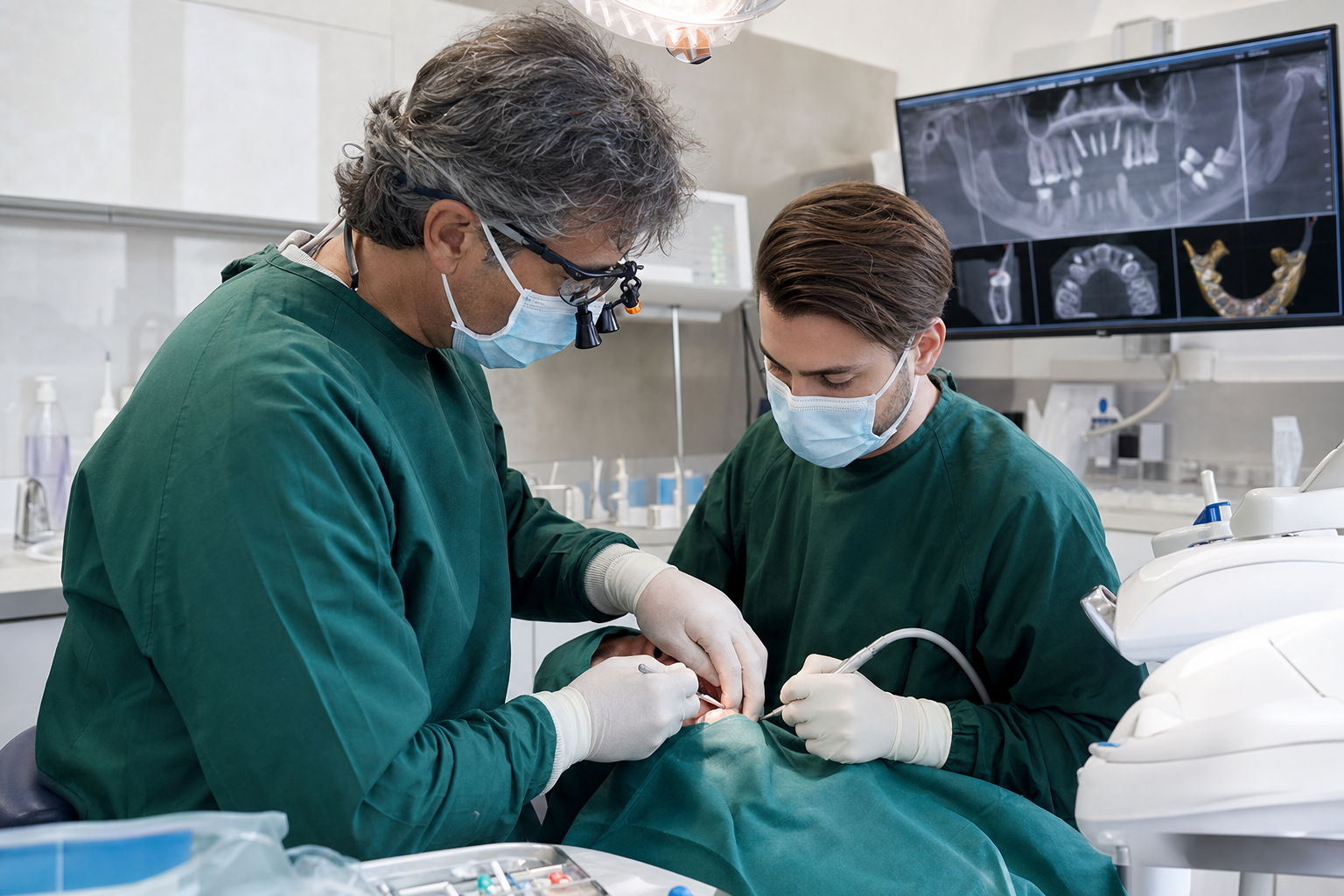
Every case begins with CBCT planning. You then learn the judgment to choose and execute the right approach—guided where it helps, freehand where the anatomy calls for it.
Learn to assess anatomy, bone, restorative position and risk before anyone picks up a drill.
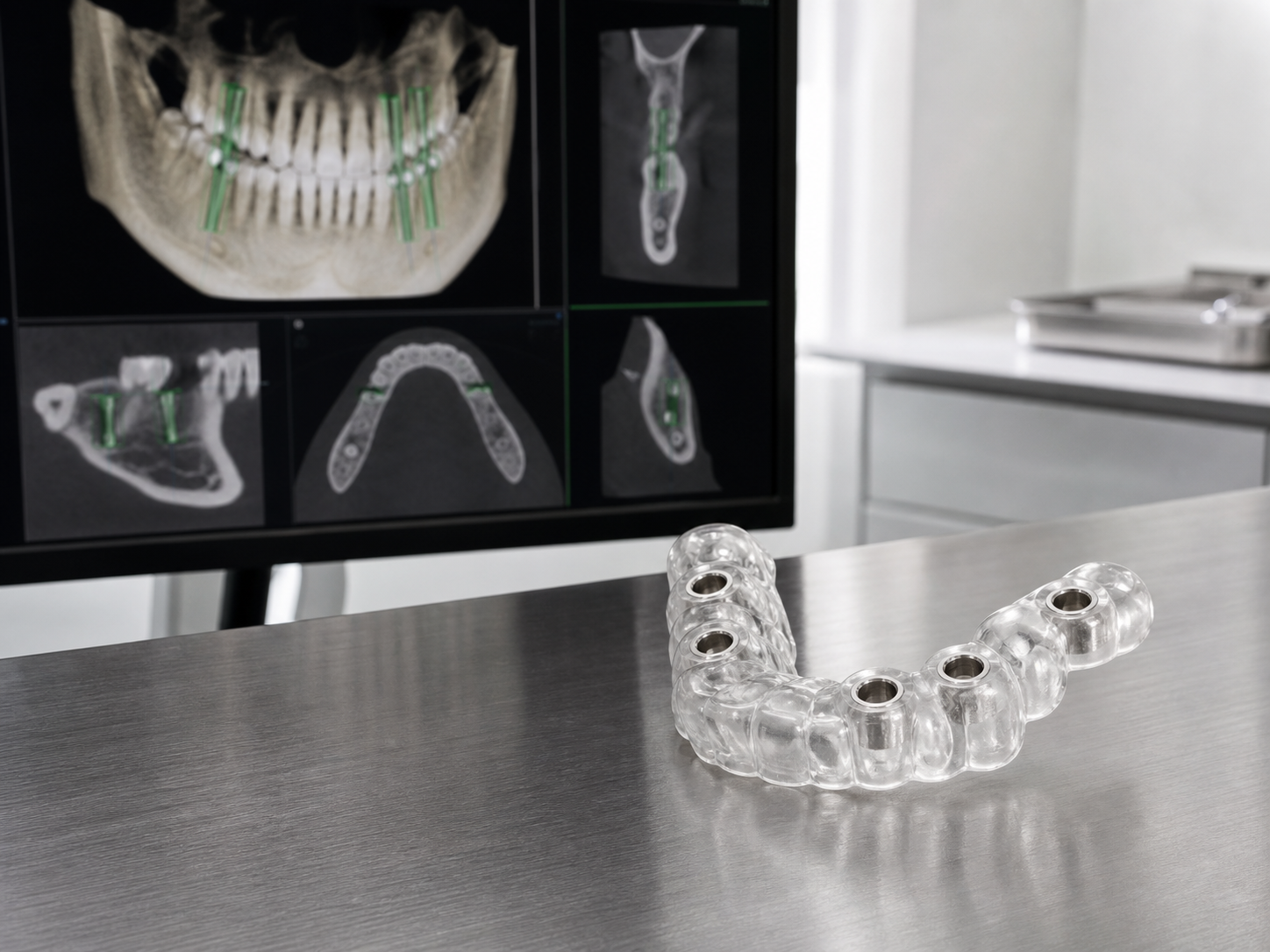
Understand what a guide can—and cannot—do. Use it where it adds control, and choose a planned freehand approach where it does not.
Place guided and freehand on live patients, and learn what to do if the guide does not fit or the case does not go exactly to plan.
Cohorts are capped at 6–8 dentists so everyone receives supervised chair time. Every case in the room is reviewed openly, so you learn from all of them—not only your own placements.
The system addresses the straightforward case types that make up 90%+ of implant work in a general practice, while the case-selection rules teach you which cases belong in the other 10%.
You know the theory and feel capable of more, but you do not yet have the hands-on repetitions, tools or mentor for your first cases.
CBCT, case selection, approach and supervised placement—repeated on well-selected cases built for a first step.
Training supports clinical development; independent practice remains subject to appropriate case selection, local regulation and professional judgment.
If you feel like you have plateaued, the appropriately selected cases you already refer out may be a responsible next step. Move the slider to see the treatment revenue those cases represent.
in annual treatment revenue represented by the cases you currently refer out, using €3,000 per completed case.
That is revenue, not profit. The surgical fee alone commonly runs €800–€1,200. The implementation system gives you a mentor for your first cases, so you are not left to work out planning and case selection alone.
Implant Studio cohorts are led by practicing implantologists—clinicians who run this workflow in their own practices, week in, week out. Across their documented implant placements, the overall complication rate is under 1%. You learn from clinicians who do the procedure, not only lecture it.
“Your first case should feel boring. That’s what predictable looks like.”
Independent implant placement means more than following a guide. You learn its limitations, when to continue freehand, and how to respond when the case does not go exactly to plan.
The goal is not to be quick for the sake of it. It is to decrease stress through sound planning, build good judgment and feel prepared for the cases you select. The curriculum also shows you how to explain and price the treatment clearly.
The strongest course is not the one with the longest lecture list. It is the one you can safely implement when you return to your practice.
The exact ordering list for your implant workflow, without months of shopping and second-guessing.
Bring your early cases for structured review before you begin treatment.
Planning questions, case selection and scan reviews in the alumni WhatsApp group.
Position implant treatment clearly and communicate the value of a planned, controlled procedure.
The course is designed around the two risks that matter: getting enough supervised repetitions in the room and implementing the workflow safely when you return home.
If you do not reach eight placements during the course, you attend the next cohort at no additional course fee.
Follow the course implementation system on your first five appropriately selected, completed cases. If they have not generated revenue equal to the course fee within six months, 1:1 planning and case-review support continues at no additional fee until they have—with no time limit.
Ask about planning, scans and case selection as you begin implementing the workflow.
The practical ordering list for the implant system, instruments and setup used in your practice.
Send three appropriately selected cases for structured review before you drill.
A clear consultation framework for explaining implant treatment, value and next steps.
A chair-side implementation plan your assistant can follow for setup, workflow and support.
Fast-action bonus: the first three seats in each cohort receive design and printing for the surgical guides used on their first three suitable guided cases back home.
Same foundation curriculum. Same placement guarantee. Choose a focused group or an entirely private schedule.
€8,900
3 days · Madrid or Budapest · live patients
Patient cases are screened and assigned against confirmed seats. Applying earlier gives the clinical team more time to match an appropriate case mix; every assignment remains subject to patient suitability and safety.
VAT treatment is confirmed after review of your billing country and VAT/tax details. Please provide your VAT/tax number when reserving.
Join Group Waitlist€16,900
3 days · Madrid or Budapest · live patients
Currently sold out
VAT treatment is confirmed after review of your billing country and VAT/tax details. Please provide your VAT/tax number when reserving.
Join Private WaitlistBone management, sinus work and complex anatomy for clinicians who already place. The waitlist receives dates and founding pricing first.
Join the no-payment waitlist for the next group cohort or private opening. We will contact you when new dates become available.
Questions before applying?
support@implantstudio.co
Your reservation secures a course place, but does not itself authorize patient treatment. After payment, you upload your professional documents securely. We confirm an operator role only after individual review of your qualification, host-country requirements, clinic approval and appropriate insurance. The remaining-balance link is normally sent six weeks before the course and is due four weeks before the course. Final operator confirmation remains separate from payment. If genuine clearance cannot be obtained despite accurate, complete and timely documents, you may choose a reservation refund, an available cohort transfer or an agreed non-clinical observer pathway under the Refund Policy.
You will place 8–10 implants on live patients across multiple cases, with a minimum of 8 guaranteed. If the minimum is not reached during your course, you may attend the next cohort at no additional course fee.
That is exactly who the foundation course is for. Every case starts with CBCT and a digital plan. A printed guide is used where it improves control; planned freehand is taught where the case calls for it. First cases are selected to be foundation-level and every placement is directly supervised.
You operate. The group course includes 8–10 supervised live-patient placements per dentist, with a minimum of 8 guaranteed. Between your own placements, you review the other cases in the room so you see more anatomy, plans and decisions without giving up your own chair time.
No. A guide does not turn an unsuitable case into a suitable one. Cases are screened and matched to your experience, and the course teaches you what to treat, what to delay and what to refer. Patient safety and sound case selection take priority over adding another placement to the count.
You learn to check guide seating, recognise its limitations and reassess before continuing. Where the plan and anatomy allow, your supervisor can guide a controlled freehand continuation; where they do not, the correct decision is to stop or change the plan. The aim is clinical judgment—not pretending a guide works 100% of the time.
It teaches foundation-level prevention and troubleshooting: CBCT risk assessment, case selection, guide-fit problems, changes in stability or anatomy, and when to stop, change approach or refer. It does not claim that three days prepare a dentist to manage every surgical complication or complex case independently.
The course is designed to move you through the complete procedure repeatedly: CBCT, case selection, planning, approach and placement. Your development continues after the course through mentorship, case review and careful selection of appropriate early cases.
You leave with the same case-selection framework used during the course, then submit three appropriately selected home cases for structured digital-plan review before treatment. Six months of WhatsApp support gives you a place to question a scan or refer a case instead of talking yourself into one that is not a sensible first step.
No one is graded on speed. The goal is to decrease stress through planning and repeat the procedure with control. Cohorts are limited to 6–8 dentists, cases are matched to experience and the schedule is built around supervised chair time. If you want the entire pace adapted only to you, choose the private 1-on-1 format.
It can be if your gap is consistent CBCT planning, case selection, guided-versus-freehand judgment or a repeatable workflow for straightforward cases. If you already handle those confidently and want advanced grafting, complex sinus work or difficult anatomy, the Level 2 waitlist is the better fit. We will give you an honest recommendation from your application.
No. Every implant is CBCT-planned, but not every implant should be guided. You learn when a surgical guide adds control and when a planned freehand approach is more appropriate. The goal is independent implant placement and sound clinical judgment—not dependence on one technique.
Patients are screened, digitally planned and booked at each campus before the cohort arrives. Reviewing those plans is part of the course.
Hotel accommodation, breakfast and lunch, and all surgical materials and instrumentation used during the course. Flights, airport transfers, dinners and personal expenses are not included.
You take home the implant equipment purchasing blueprint, treatment workflow, high-ticket patient close script and one-day assistant training protocol, plus six months of WhatsApp support and structured review of three home-case digital plans.
OralAdvance Labs d.o.o. is registered for Croatian VAT. VAT treatment depends on the legal classification and place of supply of the course, the campus and your verified business or tax status. We collect your VAT/tax number, verify EU VAT numbers through VIES where applicable, and issue the invoice using the treatment confirmed for that transaction. We do not promise blanket 0% VAT or reverse charge before that review.
The €2,700 group reservation or €4,700 private reservation immediately secures your course place and counts toward the full fee. It is separate from operator clearance. We request documents after payment. The €6,200 group or €12,200 private balance link is normally sent six weeks before the course and is due four weeks before the course, alongside the document deadline. A genuine clearance failure is conditionally refundable; a transfer to another available cohort within 12 months is also available under the Refund Policy.
Complete your first five appropriately selected cases using the course implementation system. If those completed cases have not generated revenue equal to the course fee within six months, 1:1 planning and case-review support continues at no additional fee until they have, with no time limit. This is a support commitment, not a guarantee of patient suitability, treatment outcome, profit or future revenue.
No. Everything is provided during the course. Both a paid software path through i-Implant Studio and a free path through Blue Sky Bio are taught. You go home with the equipment list for your own practice: printer, resin, drill kit and CBCT referral brief.
The group course costs less and lets you learn from every case in a room of 6–8 dentists. The private course gives you the instructor, patients and pace entirely to yourself. Choose “Advise me” in the form if you want an honest recommendation.
English.